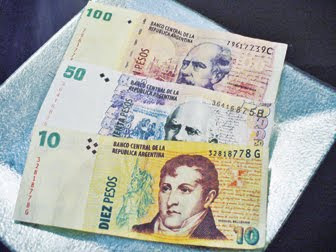
In Buenos Aires, bills come in different colors and designs. Colors indicate the denomination and the quality of the paper helps you identify whether a bill is fake.
Despite using mostly buses and trains I couldn’t resist the occasional convenience of a taxi. But beware! Taxis are usually where you get counterfeit bills.
“It’s sad but taxis are the place where you get a false bill,” leather goods salesperson Marita told me when I shared my story. “Taxi drivers identify you as a tourist and they give you change with bad money.” Giovanna, an employee at a cashmere goods store at Florida Street, said “when you take a taxi, you pay with the exact amount, always.”
A friend and I took a taxi to go see a tango show and we paid with a 100-peso bill. All our change came back fake. In the dark and in the rush to arrive on time, I just placed the money in my wallet.
When the show was over, we took another taxi back home. When I paid the 12-peso fare with a 50-peso bill the driver held it up and said, “This is fake.” I was dumbfounded. I gave him another bill and his answer was the same. I didn’t know what to do, as he was getting uneasy. “That’s not my problem,” he said. I asked him to take us to an ATM to get money. My friend rushed to the ATM and came back with two 100-peso bills. I gave him one, as I was getting ready to exit the car. “I have no change for 100,” he said. I couldn’t believe it. By that time the meter showed more than 16 pesos.
“What do you suggest we do then?” I asked. “Give me whatever you have,” he responded immediately. I handed him seven pesos.
The day after, when I was shopping with that 100-peso bill, I realized the taxi driver had switched the ATM real bill for a fake one. “That’s a known practice,” Marita, the saleswoman, told me with a shy smile.